


I’ve been filling out character progression and adding more people and places to find between the main quests. The recent village screenshots showed some of the visual work, but quite a lot has changed underneath it too. These additions are being gathered into the next alpha build; they’re not all in the download currently on the site.
Filling out the masteries
All seven mastery lines now have sixteen implemented masteries apiece: Warrior, Rogue, Magician, Skirmisher, Runeblade, Nightweaver and Wanderer. That’s 112 in total, with the same number of choices at each tier across the seven lines.
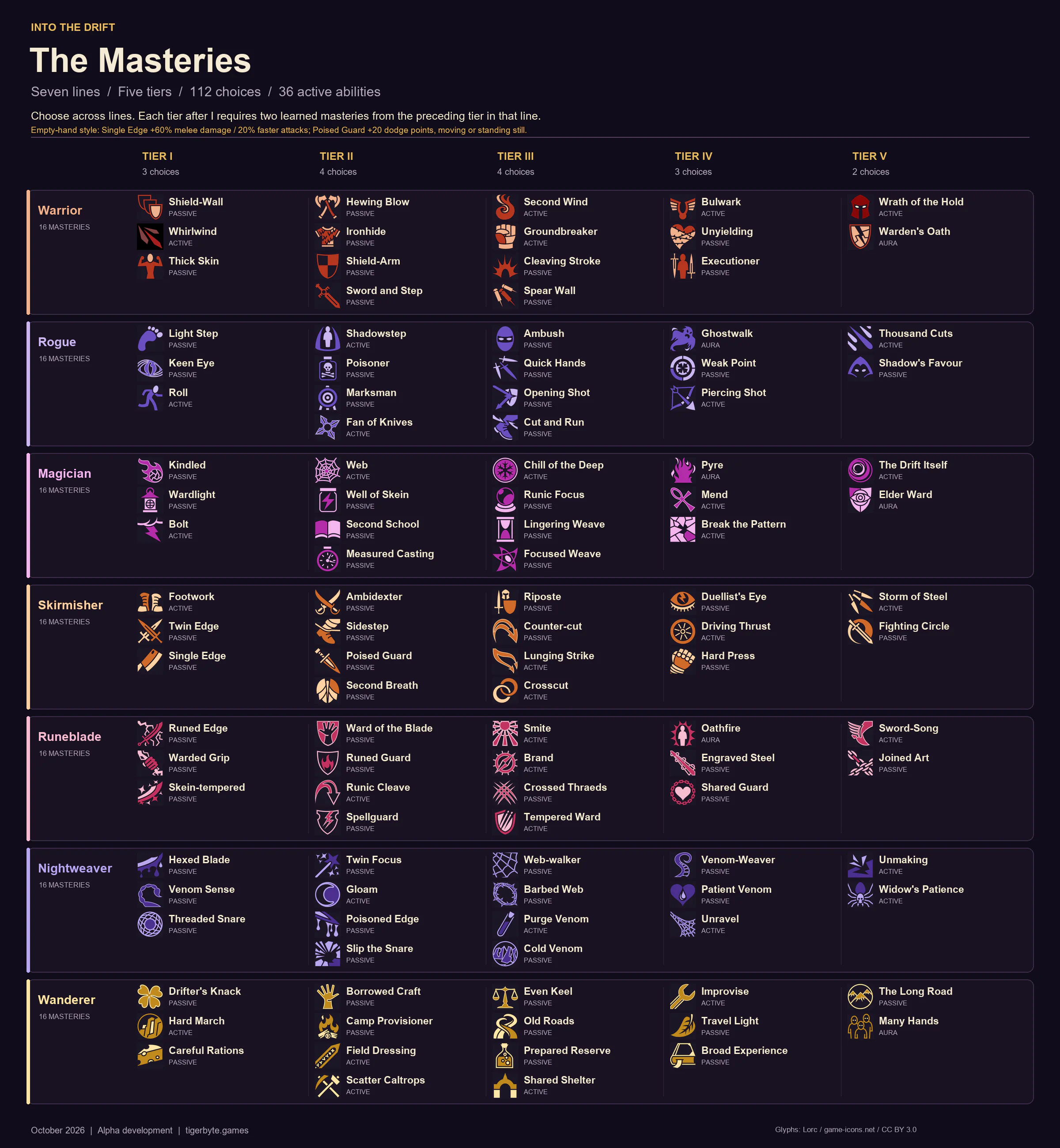
Filling empty slots was only part of the work. Some of the early choices were so broadly useful that almost any character had a reason to take them. Warded Grip was a particularly obvious example: it reduced incoming damage simply for holding a weapon, which most characters were going to do anyway.
It now gives a brief reduction in hit damage when you combine a damaging melee hit with spending skein on a thraed or mastery. That makes it useful to a Runeblade who alternates fighting and weaving, and asks something of another character who wants the same benefit. Several other early masteries have had similar attention, with their benefits tied more closely to equipment or actions that suit the line.
There are some more involved abilities further up the trees. Nightweavers can use Gloam to obscure themselves from enemies inside an area, while Wanderers can borrow a passive from another line and change that choice after resting. The later Long Road mastery lets them borrow a second, higher-tier passive. You’re still free to spend points across different lines; choosing an archetype doesn’t lock you into one.
October 20 update: The trees now include 36 activated abilities: five in each line, and six in Magician. Warriors can spin through a group with Whirlwind; Rogues can Shadowstep across clear ground, throw a Fan of Knives or fire a Piercing Shot. Runeblades get a Runic Cleave, while Magician’s Bolt explodes on impact and Chill of the Deep deals damage across its area. Several skills that used to prepare a bonus for the next attack now perform an attack when you press them.
A substantial part of this pass was making sure the abilities behave correctly for companions too. Damage, defensive effects, auras, costs and cooldowns need to belong to the character using them. A companion’s mastery shouldn’t quietly use the player’s attributes or benefit the wrong person.
The full set is implemented, but I expect more tuning once people have played with different combinations. Abilities that looked reasonable in isolation may turn out to be too strong together, or simply not useful enough to justify their cost. Existing saves receive a one-time refund of mastery purchases for the player and companions, so you can choose again under the revised tiers and abilities. The character growth guide and Codex have been brought up to date with the new rules.
More people to travel with
Brynja and Wulfgar now have more to talk about, and they’re joined by a much wider pool of possible companions. Generated recruits can turn up in inns and taverns, at the Galdorscol, in isolated cabins and occasionally out in the wild. They have their own backgrounds, reasons for travelling, ways of speaking and fighting roles.
You can ask about their lives before trying to recruit them. Some are ready to leave; others have reservations about you or the company you keep. A more experienced recruit may not be willing to follow you yet.
Some also have something they want done first. That might mean hunting a creature, clearing a camp, recovering an heirloom or gathering supplies. Helping them can persuade someone who would otherwise refuse to join. I like having a reason to spend a little time with a prospective companion before they become another portrait in the party.
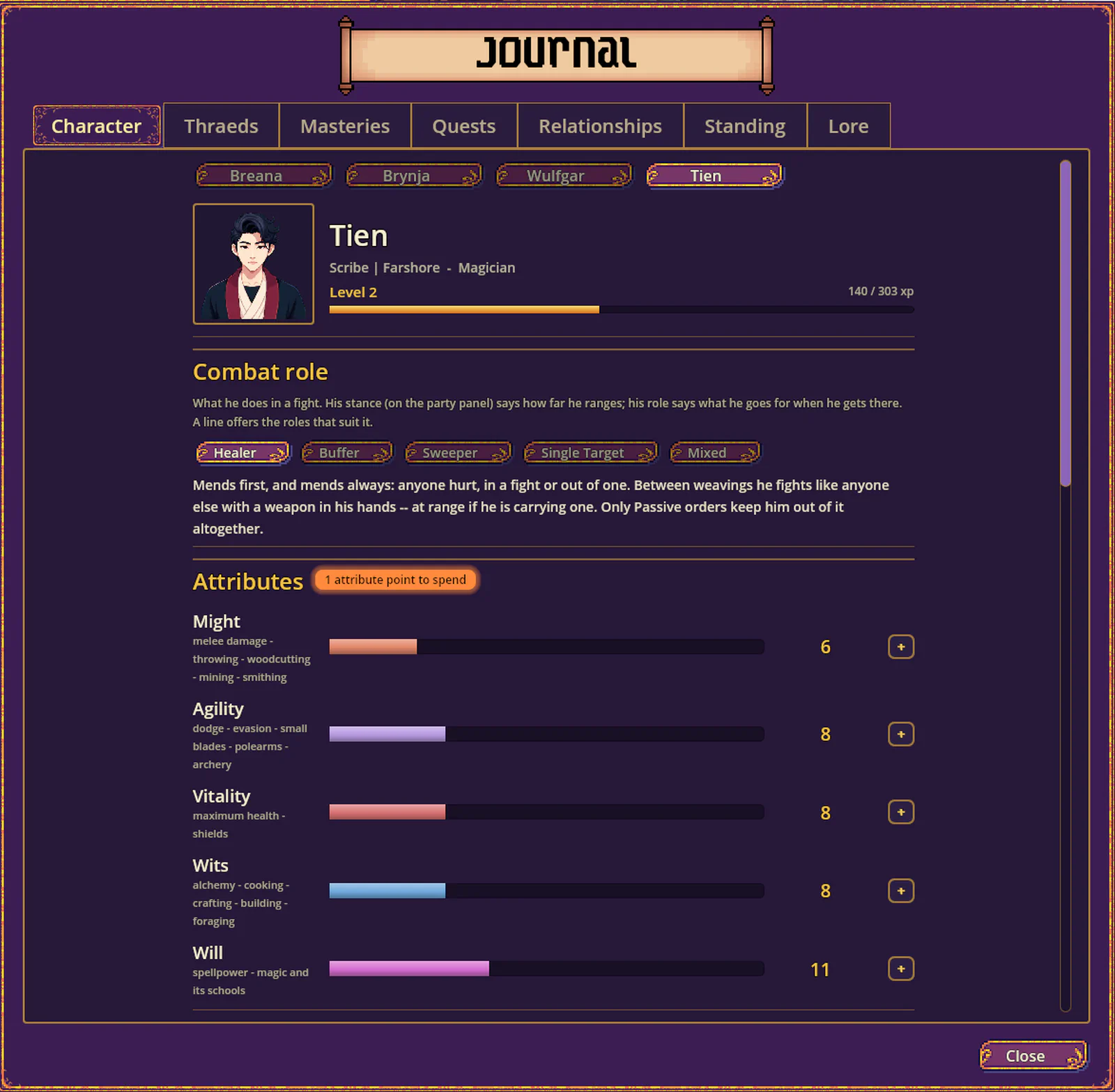
There’s more control over their development as well. Teachers can train companions directly, and companions weave from an equipped selection of thraeds. You can let the game choose a loadout for their combat role or pick it yourself. Thraeds and Masteries have separate Journal tabs, with a selector for the party member you’re working on.
Books worth opening
Readable books are now in, with fifty completed texts covering household accounts, children’s stories, local history, scholarship, recipes and other subjects. Some are practical, some are peculiar, and some say at least as much about their author as they do about the subject.
One of the children’s tales follows a cat who has managed to acquire four names and four households willing to feed him. Elsewhere, a household account book records a disputed blanket, roof repairs and a traveller who paid for supper with a spoon. I wanted room for ordinary lives alongside the histories and accounts of magic.
Bookshops can appear in human and Hēahfolc towns, and books can be found on household shelves as well as among older ruins. Booksellers sometimes want worn copies brought in, or send you looking for a particular manuscript. Reading the books themselves is there for the pleasure of finding out more about the world; it doesn’t grant a skill or unlock a recipe.
Between the towns
The countryside now has isolated family homes, craft workshops and cabins where you might find a recruit. Depending on the dwelling, there may be a garden, well, woodpile or stores around the house. Master crafters in remote workshops can carry better stock, giving you another reason to investigate a small house on the map.
These homes are occupied. Their beds and belongings aren’t automatically yours because you’ve walked through the door.
Vegetation has had a sizeable addition too: sixty-four bush species, distributed according to the landscape. Fruiting bushes can be harvested and will regrow, and the fruit goes into meals, jams, wines and cordials. Lush regions have denser growth, so the change should be visible even when you’re not out gathering ingredients.
Food and drink bonuses have also become more useful for preparing a party. Each character can keep three food bonuses and three drink bonuses at once. Eating the same thing again refreshes its bonus; adding a fourth different food replaces the one closest to expiring. Party portraits show the active effects and how long they have left.
A few other changes
- Combat now leaves blood on nearby ground, walls and objects. Wounds remain visible on a creature and diminish as it heals, and blood colours vary between creatures.
- Inventory cards have a compact view, with fuller details available by holding Shift or the controller’s right trigger.
- Notice boards have a panel for browsing and accepting jobs. You still return to the person who posted the job to collect the reward.
- A guided introduction in the first town helps point out its services and notice board.
- Cave mouths are darker when viewed from outside, and lighting and shadows have had further fixes around cliffs and changes in ground height.
The next alpha
I’m preparing another alpha build with this work included. It will likely be the last one before I tackle settlement building and the next major leg of the main quest. That is a much larger stretch of work, and I’d like to get these additions into people’s hands first.
There isn’t a release date to announce yet. In the meantime, the Dev Map shows the larger plans, and the devblog now has topic pages for following particular systems without digging through every update.