Three weeks ago, I posted a catch-up on the game’s development. Since then, I’ve added the next story location, more town services and world-map encounters. There’s also a Windows alpha you can download and play.
A build you can download
There is a Windows alpha on the Download page. It is about 600 MB zipped. It’s an early, unfinished build, so expect bugs. Windows will warn you about an unknown publisher the first time you run it, because the build is not signed yet; the page explains what to click.
I’ve also added a forum and a bug tracker to the site. One account covers both. You can attach screenshots and save files to bug reports to help me reproduce problems. You can also set up a profile with a picture and a signature, react to posts, and report anything that shouldn’t be there. If you’ve played, I’d like to hear how it went.
The Galdorscōl
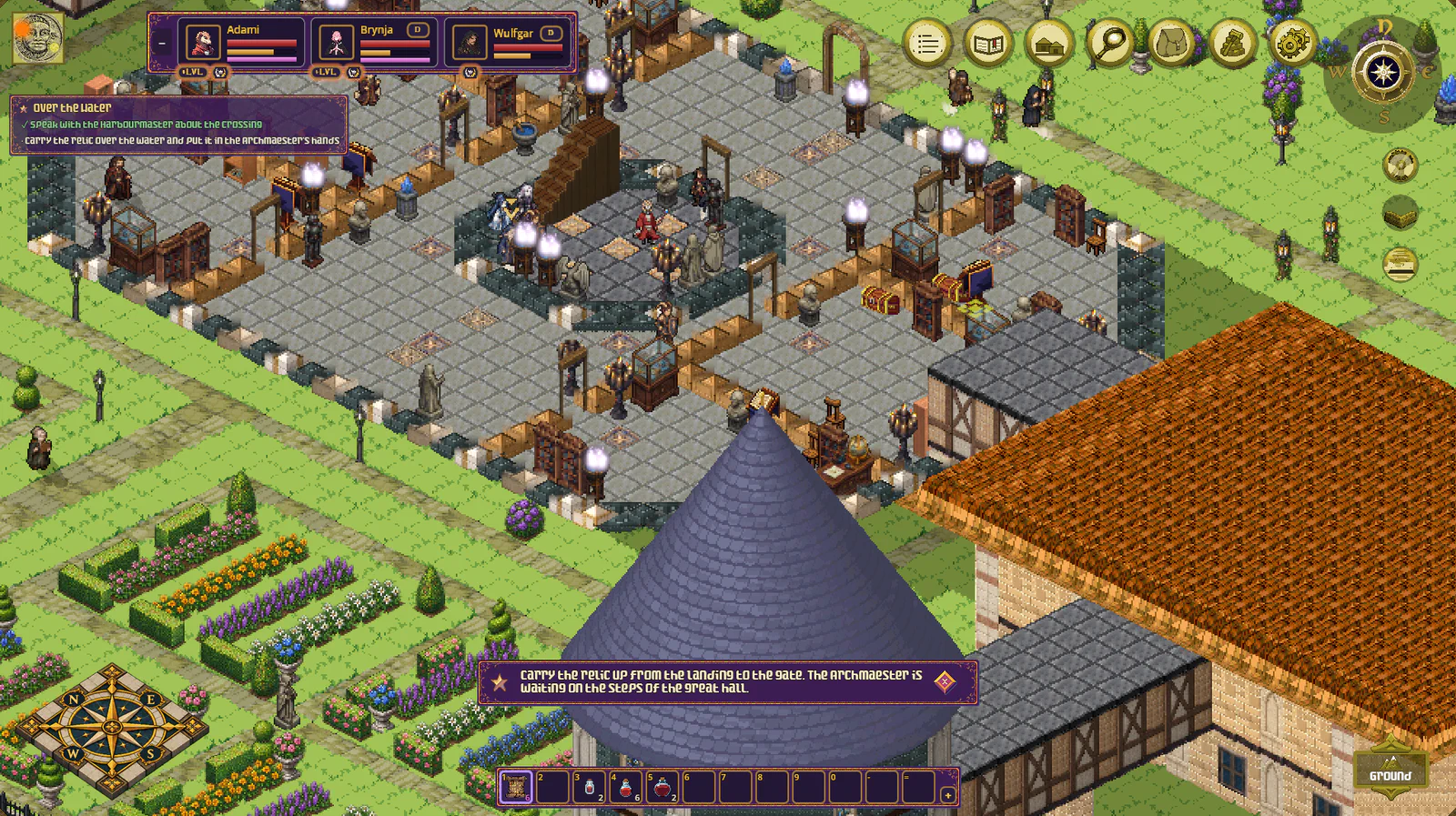
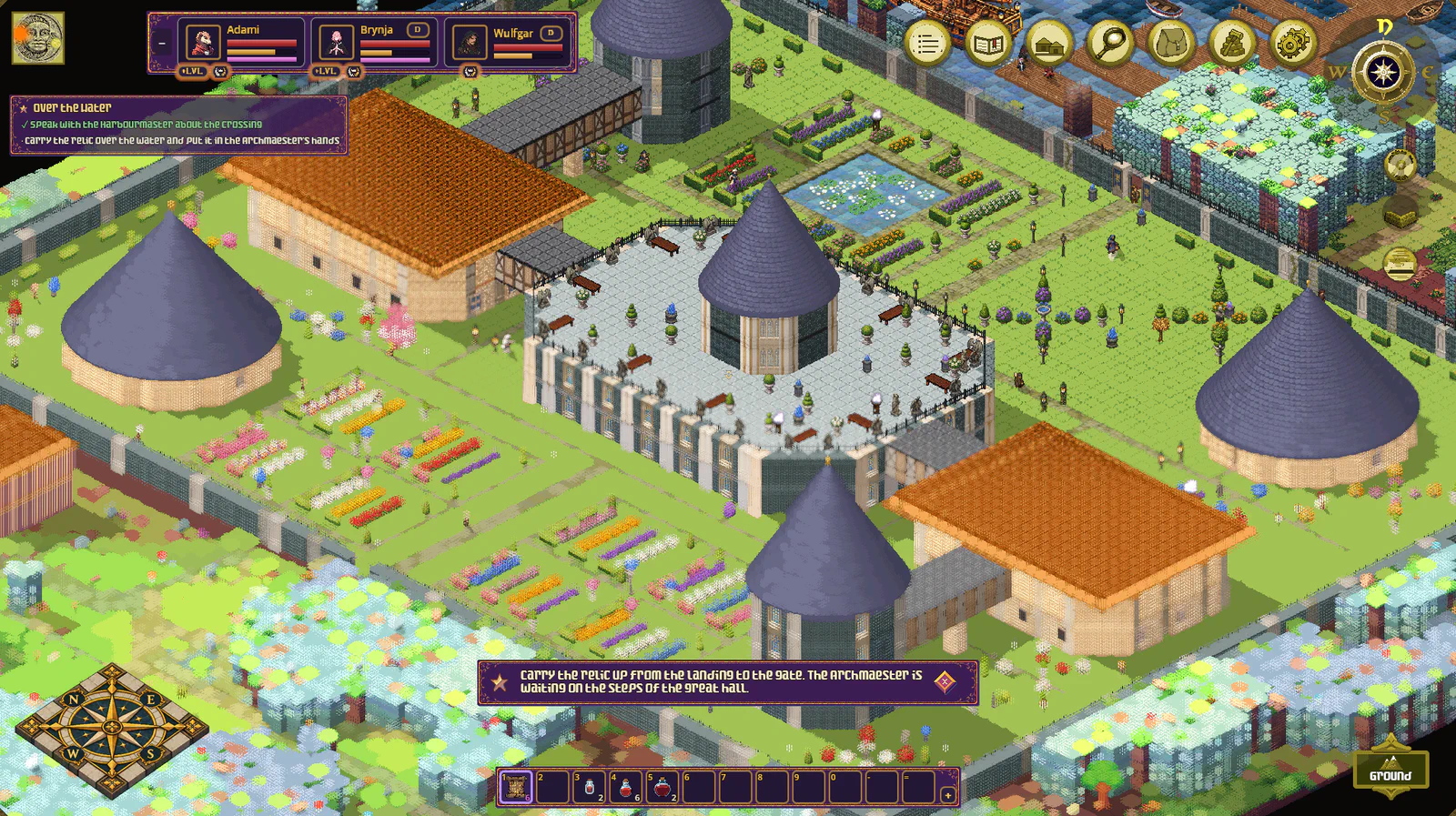
The story now continues past the harbour. The Archmaester won’t come and fetch his relic, so you carry it across the sea yourself, to the Galdorscōl, an academy that teaches all seven schools of thraedweaving.
- The academy has halls for each school of magic, towers, walkways and gardens. A small town outside the gate has a road connection and a carter.
- You can pay the masters for training in skills and thraeds. The Archivist, the Hedge Alchemist and the Potions Master also have shops.
- There are fifteen tasks available at the academy. These include lighting lamps, recovering lost specimens, investigating a flooded hall, closing a wyrdport and finding a missing master. Complete five to secure passage to Thrymyr.
- The Archivist keeps a file on Thrymyr, and Brynja wants to see it.
The Scōl is the first handcrafted location in the game, and it’s where the next leg of the story begins.
Towns that do more
- Inns and taverns. Every town has both now. A bed at the inn costs a few coins and comes with breakfast for the whole party. Villagers go to the tavern for a drink in the evening.
- Stables. Every town has a stable, or at least a carter, and a cart ride takes you to any town the roads reach. The fare and travel time depend on the distance.
- Shops with keepers and signs: smithy, general store, stable, apothecary, baker, butcher, tailor, cobbler and fishmonger, each with a hanging sign by its door.
- Errand boards. Villagers post gathering, foraging and crafting jobs, along with more dangerous requests. Some send you to a camp, mine or ruin generated for that errand, and some turn out to be more complicated than they first appear. Crafting errands introduce the trades and reward you with recipe sheets.
- Standing. Your reputation in each town and at the Scōl affects the prices you pay.
- House interiors. Houses now have separate rooms, wall shelves and objects on tables and shelves.
- Villager names. Names reflect each villager’s homeland.
Building plans
Every building piece now has to be learned before you can place it. You start with plans for a campfire and a shelter, which Brynja helps you build on the first night. The rest comes from building plans: carpenters sell plans for timber, joinery and furniture, smiths for forges and ironwork, gardeners for garden pieces, and merchants for stonework.
The construction system is working well. The next step is letting villagers move into your buildings and work in your settlement. Founding a settlement will become part of the story in the next leg, and the full set of plain building pieces will unlock then. There’s more on this at the end.
The road
World-map travel now takes time, and your party needs food for the journey. Crossing sixteen cells on foot takes a full day, so you may still be travelling when night falls. Roads are quicker and safer. You and your companions get hungry as the hours pass. Starving characters move more slowly and are weaker in combat.
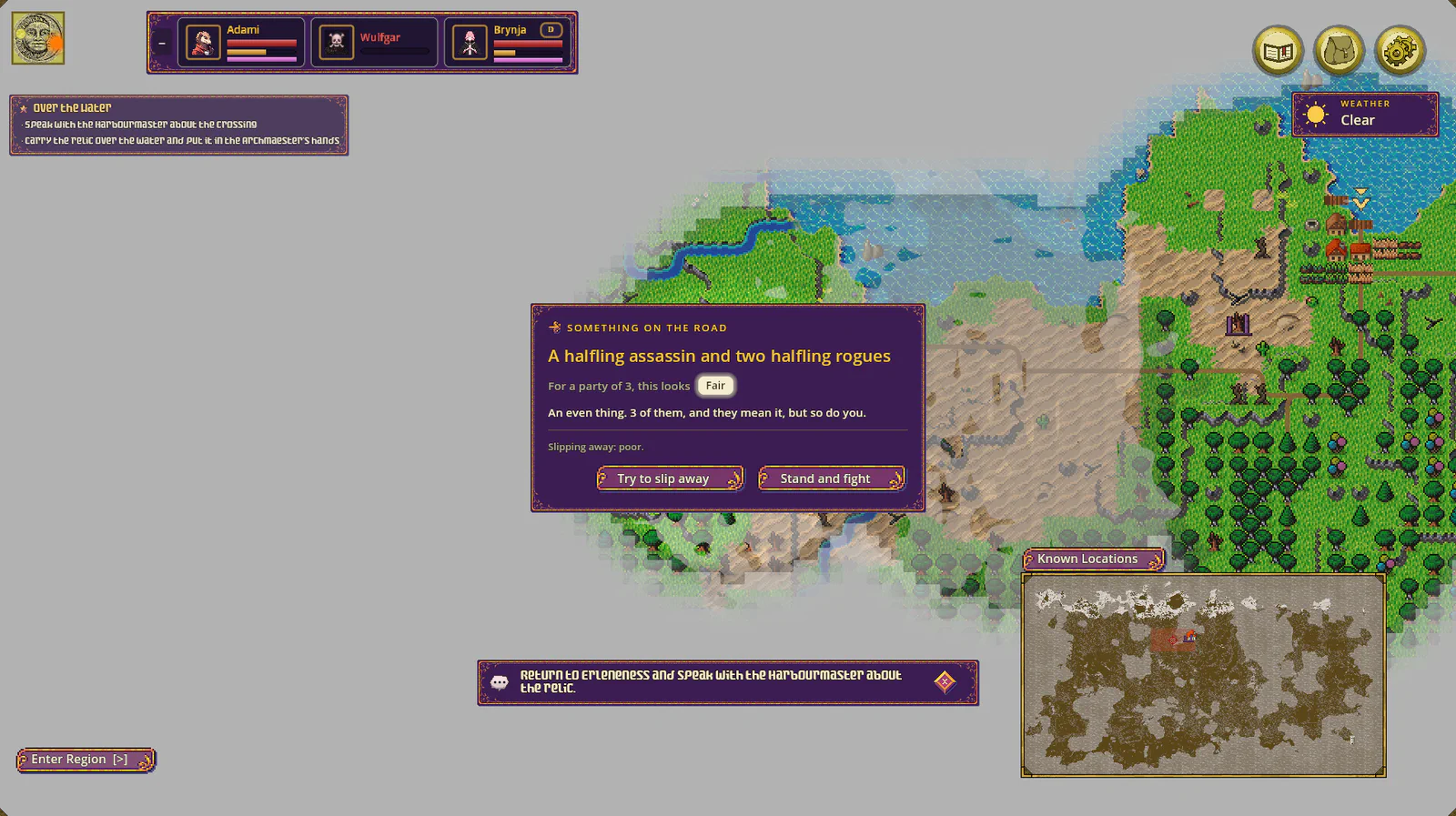
You can encounter enemies while travelling. Each encounter shows a difficulty rating based on your party, and you can choose to fight or try to escape. Fights take place on a separate battle map, with the loot collected in a chest afterwards.
Regional weather now appears on the world map and changes as you travel. A panel shows the current conditions, while the quest tracker and map marker help you find your next objective.
Creatures
- Ninety-six new enemies in five tiers, with mini-bosses, and enemies that weave thraeds of their own.
- Broodmothers that release their young when you approach.
- The wilds, ruins and caves now draw from the whole bestiary, with rarer creatures found in specific places: flower fields, crags, shrines, cave mouths, blighted forests.
- Every animal carries meat now, and the beasts you hunt yield parts for armour, weapons, draughts and dishes.
Smaller things
- Swimming in deep water.
- Crossbows and hand crossbows, with new artwork.
- Fog in damp, green regions on misty days.
- Improved lighting: walls and characters cast shadows from lamps, torches and fires. The lighting works across multiple storeys and underground.
- Distinct music for each biome and for caves, plus sound effects for every school of thraedweaving.
- A compass rose, a colour-coded message log and an interface tutorial for new players.
- Recipes count an ingredient across stacks, so two kinds of mushroom satisfy “two mushrooms”.
- Notifications when you receive a quest or gain a level.
What’s next
The next leg of the main story is nearly ready and should go in within a week or two. It will introduce settlement founding and unlock the basic building pieces. After that, I’ll add jobs for villagers: building from your blueprints alongside you, farming, tending animals, keeping watch, and working at stations on your orders.
I also plan to add settlements for the Drift’s other peoples. All towns currently in the game are human. The thanes, Brynja’s people, will have their own villages, as will the elves. The Hēahfolc, the mountain people from whom the Numidorians descend, will have terraced towns along the cliffs. They have a poor relationship with the dwarves living beneath those mountains.
Human towns will also vary by culture, including the lowland heartland where the story begins, the desert peoples to the south, and traders from overseas. I’ve prepared villager sprites for several of these peoples; their settlements still need to be built.
The Dev-Map is up to date with these changes and plans. Thanks for reading, and if you try the build, tell me what broke.
Screenshots from this build