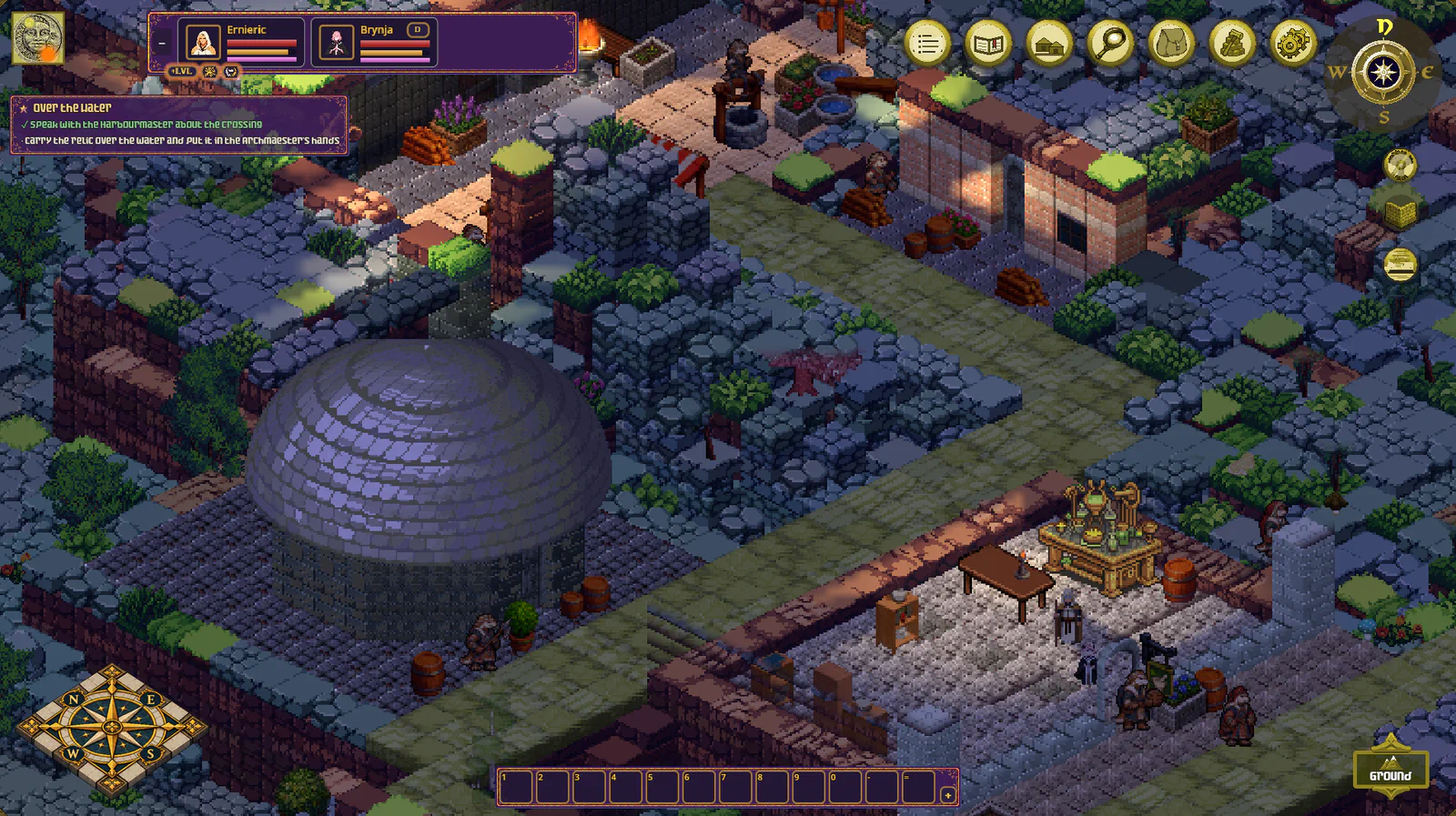
In the last update I mentioned that the Drift’s other peoples would get settlements of their own. I’ve now added towns for the Hēahfolc, a mountain people who dig their homes into cliff faces. Getting those towns to look and work properly took a few attempts.
A new Windows build with all of this is on the Download page.
The Hēahfolc
Who they are
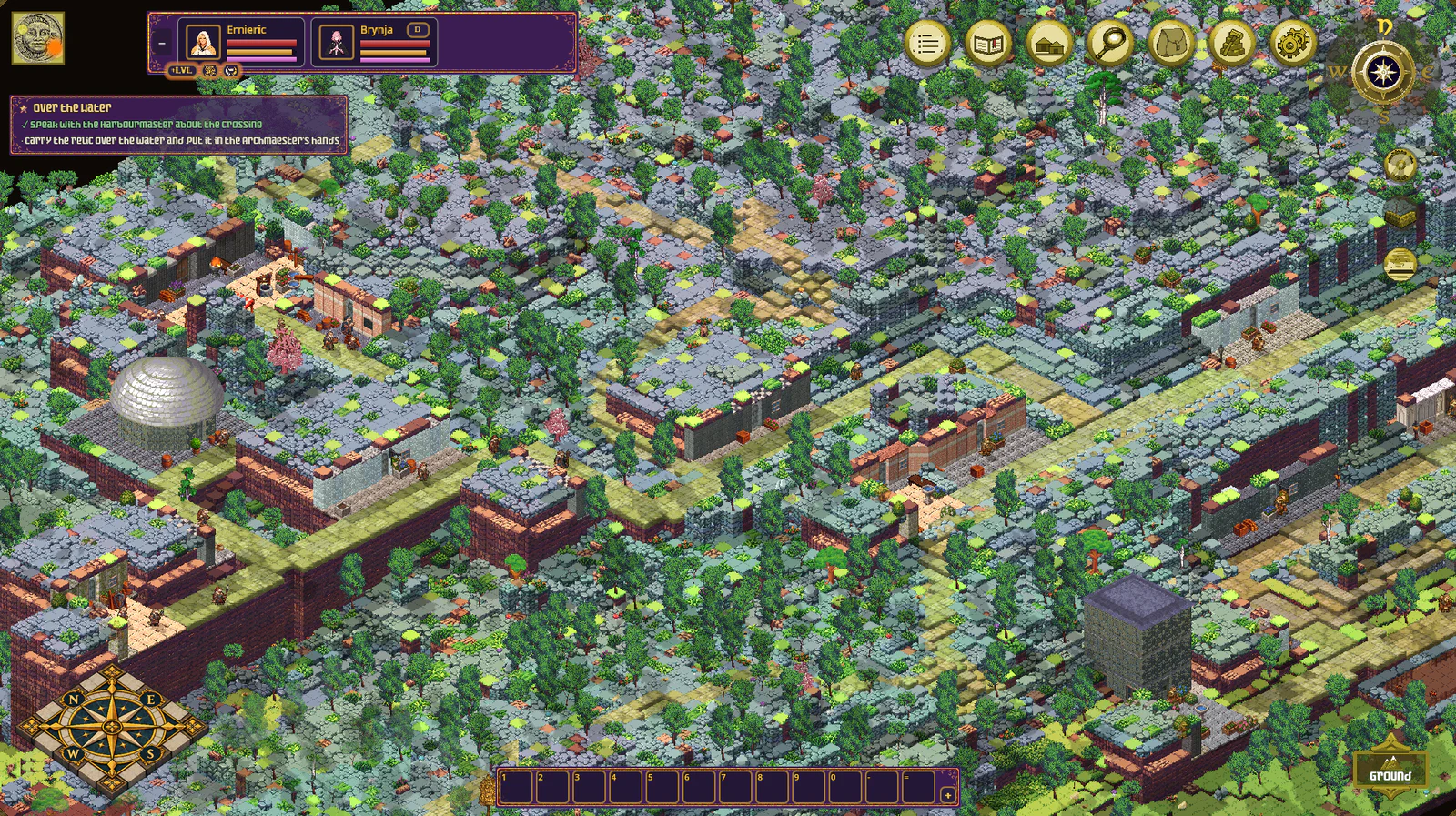
The Hēahfolc (“high folk”) are a scaled people who live on the Drift’s mountains. Their towns are dug into the cliff faces, with a road winding up between the homes. Several related families share a home and its work; the Hēahfolc call this group a hearth, and they call the town as a whole the Height.
They keep careful accounts. A clerk records what each hearth owes and what work it has done, and the accounts are settled once a year at a public Reckoning. Some disputes are settled by a bout with the Elder as witness. Each town keeps a band of fighters called the axe-line, and a guest of the Height is under its protection. They keep herd ants to carry loads and grow mushrooms in caves.
They trade with the dwarves, who live inside the same mountains, and with the human towns in the valleys. The Hēahfolc call the dwarves the under-folk, and the two peoples are rivals more than enemies. Their real enemies are the Dracanfolc, lizard-like raiders they call the dragon-get and see as a twisted, lesser version of themselves.
The Hēahfolc are also the ancestors of the Numidorians, one of the five peoples you can play. The Numidorians’ forebears left the Drift for Ahtar long ago. They retain their ancestors’ natural armour and are still known for their skill in mountainous country.
I’ve given them more formal, deliberate speech than the lowland villagers, along with conversations about their work, customs and neighbours. You can ask the Elder, clerk, miner, porter, Axe-Warden and goodwife about life in the Height, or take on errands for its hearths.
Building their towns
The first version put rows of identical houses along a flat wall of rock. It worked, but it looked like a terrace of human houses painted grey, and the land around it didn’t read as a mountain. I started again with real cliff villages in mind, especially the cave towns of Cappadocia and the loess villages of Shanxi, where one row of homes stands on the roofs of the row below.
I began the rebuild with the mountain itself: a high central peak, smaller peaks and spurs, and a valley along one edge for the road into town. Ridges rise towards neighbouring mountain regions so the range continues across their borders. To make the mountains tall enough, I doubled the number of height levels the game supports, from 18 to 36. That meant reworking how collision, lighting and shadows assign layers, since the engine’s layer masks only go so high, and changing how high ground is brightened so pale stone near the summit didn’t turn white.
Each dwelling has a stone front with a door and windows, a yard in front, and rooms cut back into the mountain behind it. The natural mountain is the roof. Early versions cut the slope down into a mound over each house, which looked wrong and caused a run of bugs where you could walk onto a roof and drop straight into the room below. I had to reshape the rock over the rooms and leave more space beside them to stop that happening. When you go inside, only the roof of the room you’re in fades away.
The first interiors were tiny, so I enlarged them to roughly the size of a village house and added partition walls. A few homes also have stairs down to an undercroft.
Alongside the homes dug into the cliffs there are stone houses, round houses with domed or conical roofs in four styles (stone, mossy stone, red clay and timber), and three-storey towers. Each town has a temple, a hall that serves as its tavern, a bazaar on a terrace, an underground bazaar, shops with signs, mushroom caves, herd-ant pens and gardens. A stable with a carter and penned horses stands at the foot of the mountain.
The road winds up the mountainside, with ramps between levels and side lanes leading to small groups of homes. There are gardens, seats and sparring grounds for the axe-line along the way. At one point I tried rebuilding the town as stacked, Minas Tirith-style terraces. It looked too regular, and I went back to the winding road.
You enter town along a road connected to the wider road network. On the world map, a Hēahfolc town appears as a cluster of small cave-house symbols with a larger hall among them.
I’ve also added music, loading messages and villager artwork for the Hēahfolc. There are two to seven of their towns in each world, on mountains that border lower land.
Hēahfolc errands
The job boards offer work such as carrying timber up from the valley or bringing in stone, ore, pelts for winter cloaks, torches for the lower terraces and whetstones for the axe-line. There are also dangerous jobs: hunting a mountain beast, driving off a Dracanfolc raiding party, bringing a hearth’s heirloom home from a ruin, and clearing predators out of a cave where a hearth keeps its herd ants. In that last one you need to kill the intruders while keeping as many of the ants alive as you can. Every ant that dies lowers the reward.
The peoples of the Drift
All five playable peoples trace their ancestry to the Drift:
- Albans descend from the lowlanders, the humans of the Drift’s lowlands, where the game begins.
- Aranians descend from the Deshru, the humans of the Drift’s deserts. Their elven blood came later, on Ahtar.
- Numidorians descend from the Hēahfolc.
- Zhonghai descend from the Junghae, seafarers from beyond the edge of the charted Drift.
- Ahrun descend from the thanes, the horned, long-lived people Brynja belongs to.
The Drift is also home to elves, dwarves and the Dracanfolc. All of these peoples now have entries in the Journal’s Lore section and in the Codex, and each of Ahtar’s peoples has a note about its Drift ancestors.
I’ve also added a History category to the Journal and Codex. Its first two entries cover the exodus from the Drift to Ahtar and Terra, the first world.
Other changes
- Building plans come in smaller sets. Large sets of plans were too cheap for what they taught: the full set of 84 garden pieces cost 180 coins. Plans now come in sets of about ten pieces, cost around fifteen coins per piece, and each merchant carries a fixed few sets, so you’ll need to visit different towns to collect them all.
- Larger village houses. Village homes and shops are now two to three tiles larger in each direction.
- Ugru. Most ugru are ordinary trees. Some have quickened and become dangerous, and a quickened ugru casts no shadow. Villagers in ugru forests will warn you about them. They kill any that grow too close to their homes.
- More to talk about. Village tradespeople, Hēahfolc townsfolk, and the masters and staff of the Galdorscōl have longer conversations with a choice of questions about their lives and the world.
- I’ve also fixed several crashes that could occur when entering towns, along with other bugs.
Taming creatures
You can now bind creatures to your party with a Rune of Subjugation.
A Wealdend, a master of subjugation, can teach you to use the rune. Wealdends keep tamed creatures in their menageries. There is always one in the town outside the Galdorscōl, and some villages and Hēahfolc towns have one too. Training costs 5,000 coins, and runes cost 900 each. Runes are also found, rarely, in deep ruins and dungeons.
The creature must be at half health or less before you can use the rune on it. Wounding it further improves your chances, provided you keep it alive. Beasts are easier to bind than sentient creatures, and lower-level creatures are easier than stronger ones. Each attempt consumes a rune, whether it succeeds or fails.
Once bound, a creature joins your party and fights alongside you. Its portrait appears in a smaller row beside your companions, which you can collapse or hide. You can see their health and hunger like any companion. A bound beast is named “Tame” plus its kind (a Tame Timber Wolf, for example), and a bound thinking creature arrives with a name of its own. You can rename either.
Beasts can carry food to eat, but no other items. Sentient creatures can carry items and use equipment like your other companions. A bound creature heals when you rest, and thraeds and potions work on it. If one dies, resting won’t revive it. You’ll need to take it to a Wealdend.
Subjugation has an uneasy place among the Drift’s magical arts. Some of the Galdorscōl’s masters dismiss it as a lesser craft; others see uses for it, though they disagree about when it should be practised. Binding a sentient creature is especially contentious. You can ask the masters, the Wealdend and villagers what they think. Wealdends also mention the arenas in the Drift’s cities, where bound beasts fight for prize money and bound thinking creatures are forbidden. The arenas aren’t in the game yet, but they’re planned.
What’s next
The next leg of the main story, with settlement founding, is still the main priority. After that, more of the Drift’s peoples will get their own settlements: thane villages, elven towns and dwarven holds.
Thanks for reading. If you try the new build, tell me what broke on the bug tracker or the forum.